Africa’s connectivity is directly dependent on data transport infrastructure
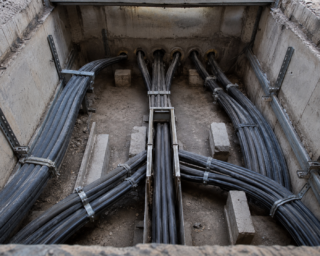
Connectivity in Africa cannot be understood without analysing its physical foundation: data transport infrastructure. Behind every internet connection lies a complex architecture made of submarine cables, terrestrial fibre networks, and interconnection systems that enable data flow across local, regional and international levels.
These infrastructures form the true backbone of Africa’s digital ecosystem.
An invisible but essential architecture: data transport networks
Internet access relies on a physical infrastructure composed of :
- International submarine cables
- Terrestrial fibre optic networks
- Internet Exchange Points (IXPs)
- Regional and continental backbones
These elements enable data transmission across continents, countries, and regions. However, this architecture remains fragmented and dependent on external routes, limiting overall network performance across Africa.
A critical dependence on submarine cables and international transport systems
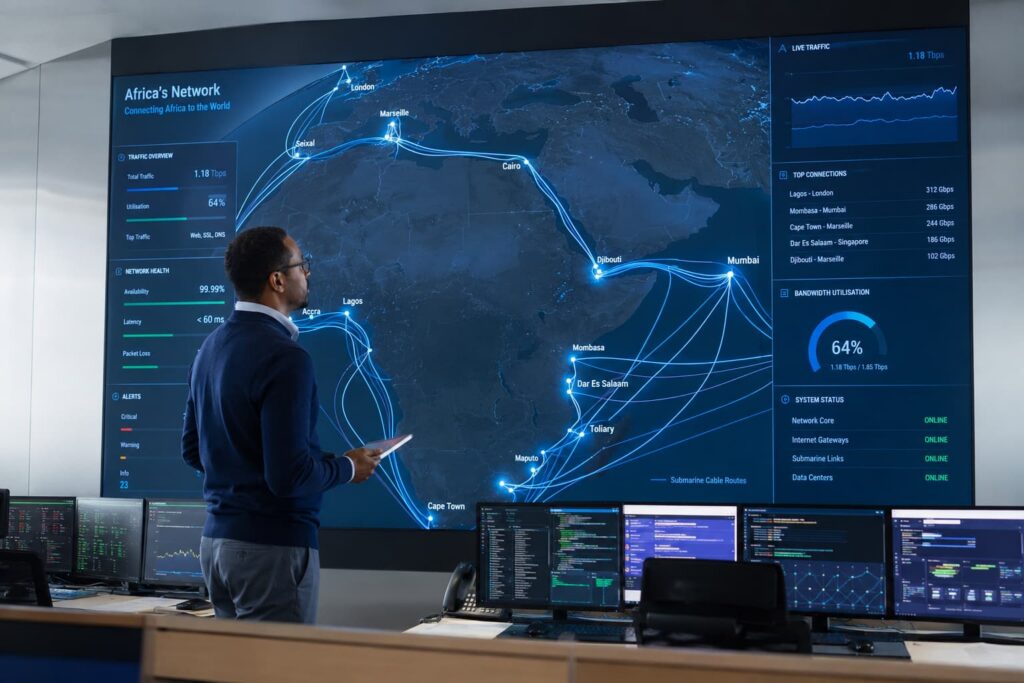
Global connectivity is largely built on submarine cable systems. For Africa, this translates into a direct dependence on a limited number of cables and landing points connecting the continent to global digital hubs. This configuration significantly shapes the performance and resilience of Africa’s connectivity landscape.
Strategic infrastructure enabling access to the global network
Nearly 99% of global internet traffic is carried by submarine cables.
These infrastructures enable :
- Access to global cloud platforms
- International data transit
- Connectivity for critical digital services
This concentration of traffic on a limited number of physical routes creates a strong structural dependency for Africa.
Cable infrastructure exposed to systemic risks
The central role of submarine and fibre infrastructure makes the system highly sensitive to disruptions. Recent incidents in West Africa have demonstrated that connectivity depends on critical infrastructure whose failure can trigger major economic and digital disruptions.
Recent incidents highlight system fragility
The 2024 cable disruptions affecting ACE, SAT-3, WACS and MainOne resulted in:
- Major connectivity losses
- Disruptions of local networks
- Interruptions of critical digital services
These events confirm that cable and fibre infrastructures are not merely technical systems but strategic assets essential to economic continuity.
A terrestrial backbone still under development and insufficiently interconnected
Beyond submarine cables, Africa’s network performance also depends on its terrestrial fibre backbone. This internal infrastructure plays a key role in distributing data across territories and enabling inter-country connectivity, yet it remains underdeveloped in many regions.
A fragmented fibre infrastructure across the continent
Africa’s terrestrial backbone is still characterised by:
- Uneven geographic coverage
- Limited cross-border interconnection
- Reliance on selected regional corridors
This results in inefficient data circulation and a fragmented continental network.
Persistent reliance on international hubs and external routing paths
Due to limited regional interconnection, a significant portion of African internet traffic still passes through hubs located outside the continent. This indirect routing architecture directly impacts network efficiency and highlights the strategic need for stronger intra-African data routes.
Data flows still dependent on external infrastructure
In many cases, African data traffic:
- Leaves the continent
- Transits through international hubs
- Returns to its final destination in Africa
This model increases latency, reduces efficiency and reinforces structural dependency on external infrastructure.
Connectivity as the result of a complex cable infrastructure architecture
Connectivity quality in Africa is not only driven by visible digital services but primarily by the underlying physical transport infrastructure. These systems determine the overall performance of digital ecosystems across the continent.
Network performance determined by physical infrastructure
Connectivity depends on :
- Submarine cable density
- Terrestrial fibre backbone quality
- Regional interconnections
- Route redundancy
These elements directly influence speed, stability and resilience of Africa’s digital infrastructure.
- Connectivity in Africa is fundamentally built on submarine and terrestrial fibre optic infrastructure
- Submarine cables remain the primary gateways to global internet traffic and cloud ecosystems
- The terrestrial fibre backbone is still fragmented and unevenly interconnected across the continent
- This fragmentation leads to dependency on external international hubs for data routing
- Network performance is directly shaped by the quality, density and redundancy of cable infrastructure
- Africa’s digital connectivity is therefore not only a coverage issue, but a data transport infrastructure challenge
- Strengthening fibre networks, submarine systems and regional interconnections is critical to improving resilience
- In this ecosystem, infrastructure players like SILVER LINKS play a strategic role in enabling continental and global connectivity