
In today’s digital economy, connectivity is no longer a technical topic reserved for network engineers. It has become a strategic pillar at the core of business performance, competitiveness and operational continuity.
Every second, millions of transactions are executed, data is transferred, cloud applications are accessed and digital services are consumed across the world. All of this activity relies on one fundamental condition: continuous network availability .
However, this massive dependency introduces a critical and often underestimated risk: the vulnerability of digital operations to network disruptions .
A network outage is no longer just an IT incident. It can result in:
- disruption of critical services
- suspension of financial transactions
- unavailability of cloud applications
- breakdown of communication between teams and customers
- immediate economic losses
In this context, one concept becomes central: network resilience .
But understanding network resilience is not enough. We must also understand what enables it: a global architecture built on connectivity infrastructure particularly terrestrial and submarine cable systems that ensure the continuity of global data traffic.
The growing cost of disruption in a connected world
In an increasingly digital economy, businesses no longer operate as isolated entities. They are now part of fully interconnected ecosystems where every process depends on a continuous flow of data.
This structural dependency on connectivity fundamentally transforms operational risk. A network disruption no longer affects only an IT system it can simultaneously impact production, logistics, finance, and customer experience.
Modern organizations rely on cloud environments, SaaS applications and distributed architectures. This means their daily operations are directly tied to the stability of network infrastructure.
In this environment, the cost of downtime goes far beyond a technical issue. It extends across the entire business value chain.
Even a short interruption can lead to:
- disruption of critical services
- degraded customer experience
- immediate productivity loss
- disruption of financial flows
- reputational damage
As the economy becomes more digital, the cost of instability increases significantly. This evolution has made network resilience a strategic business priority.
Today’s businesses depend on connectivity more than ever
Digital transformation has reshaped enterprise architecture. Local systems have progressively been replaced by cloud-based, distributed and globally interconnected infrastructures.
Today, businesses depend on connectivity to:
- access core business applications
- manage real-time operations
- interact with customers
- coordinate remote teams
- execute critical transactions
In this model, the network becomes an invisible yet essential infrastructure for business continuity.
When connectivity fails, business suffers
When a network outage occurs, the impact goes far beyond the technical layer.
It translates into:
- immediate operational disruptions
- direct or indirect financial losses
- widespread productivity decline
- degraded user experience
- loss of trust from customers and partners
In an economy where availability is a baseline expectation, downtime is perceived as a critical failure.
Understanding network resilience beyond uptime
Network resilience is often reduced to uptime or service availability. However, its true nature is far more complex.
It is not simply about preventing failures it is about ensuring systems continue operating despite them.
A resilient infrastructure is capable of absorbing disruptions, automatically switching to alternative paths and restoring services with minimal impact on users.
This concept has become essential in an environment where networks face increasing pressure: traffic growth, architectural complexity, rising failure points and higher performance demands.
Resilience is therefore not a standalone technical feature. It is a systemic capability built on technologies, processes, and network architectures.
Network resilience: a business-critical capability
Network resilience can be defined as the ability of a network to maintain essential services under all conditions.
It relies on the capacity to:
- anticipate incidents
- absorb disruptions
- maintain critical services
- restore connectivity rapidly
In a digital economy, this capability is directly linked to business performance.
Resilience is a system, not a feature
Resilience is not driven by a single element but by a combination of interconnected components:
- redundant infrastructure
- route diversity
- automated failover mechanisms
- real-time monitoring
- multi-path architectures
- business continuity planning
This systemic approach transforms resilience into a true operational model.
Resilience vs redundancy: a strategic distinction
Redundancy refers to having additional resources available. Resilience refers to ensuring continuous service delivery.
Redundancy is structural. Resilience is functional.
This distinction is critical to understanding why some networks remain vulnerable despite significant investments.
The invisible infrastructure behind business continuity
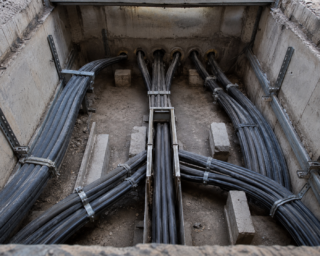
The global digital economy relies on a largely invisible physical infrastructure: terrestrial and submarine cable networks.
These infrastructures form the backbone of the internet and international data exchange.
Without them, cloud services, digital platforms, international communications and financial systems could not operate at their current scale.
This reality is often underestimated, even though it is fundamental to global digital continuity.
Why cables remain the backbone of global connectivity
Today, more than 95% of international data traffic is carried through submarine cables.
These infrastructures enable:
- intercontinental connectivity
- access to global cloud services
- operation of digital platforms
- international financial transactions
- interconnection of data centers
They form the backbone of the global digital economy.
Cable infrastructure as a resilience engine
Cables are not only data transport systems. They are a core pillar of network resilience.
They enable:
- diversification of transmission routes
- elimination of single points of failure
- continuity during localized outages
- traffic redistribution during congestion
This architecture is what allows connectivity providers like SILVER LINKS to ensure stable and resilient international connectivity.
Why network resilience is critical for Africa’s digital future
Africa is currently experiencing rapid digital transformation driven by fintech, cloud adoption, mobile services and public sector digitization.
This growth is accompanied by increasing dependency on connectivity infrastructure.
In this context, network resilience becomes a key factor for stability and competitiveness.
A network disruption can impact not only businesses, but also essential services and entire local economies.
Africa’s digital acceleration
The continent is rapidly adopting digital technologies across sectors such as financial services, telecommunications, government services, e-commerce, cloud and data center ecosystems
This momentum reinforces the need for reliable and resilient infrastructure.
Infrastructure as a growth enabler
Connectivity infrastructure plays a critical role in reducing digital divides, accelerating innovation, enabling regional integration and attracting foreign investment.
From connectivity to business confidence
In today’s digital environment, businesses are no longer looking for connectivity alone.
They are looking for reliability, stability and continuity.
Resilience therefore becomes a strategic trust factor.
Resilient networks as a competitive advantage
Organizations with resilient networks benefit from:
- stronger operational continuity
- reduced risk exposure
- more stable customer experience
- predictable performance
The rise of the always-on economy
The modern digital economy operates continuously.
In this model:
- downtime is no longer acceptable
- availability becomes the norm
- continuity becomes a baseline requirement
- Connectivity has become critical infrastructure for modern businesses
- Network resilience is essential for business continuity
- Resilience goes beyond redundancy and requires a systemic approach
- Terrestrial and submarine cables are the invisible foundation of the digital economy
- Route diversity is key to ensuring network stability
- Resilience is a strategic driver of competitiveness in the digital era